Hi, Barbie!
For weeks, my Instagram feed has been filled with pink, pink, and more pink. I have seen so many cute stacks of Barbie-inspired books, either in color or theme.
I saw the Barbie movie a few weeks ago expecting a light and fun movie, but left having an existential crisis and a renewed love for the human experience (yes, the movie is THAT good). After watching, I wanted to add all the books I feel emulate some of the themes and ideas of Greta Gerwig’s latest masterpiece.
Also, I saved the best book for last, so don’t forget to check out the book I cannot stop thinking about.
(Major spoilers ahead: I discuss some of the major plot points and themes of the movie, so if you haven’t watched the movie yet, watch it…then come back and read this post 😊)
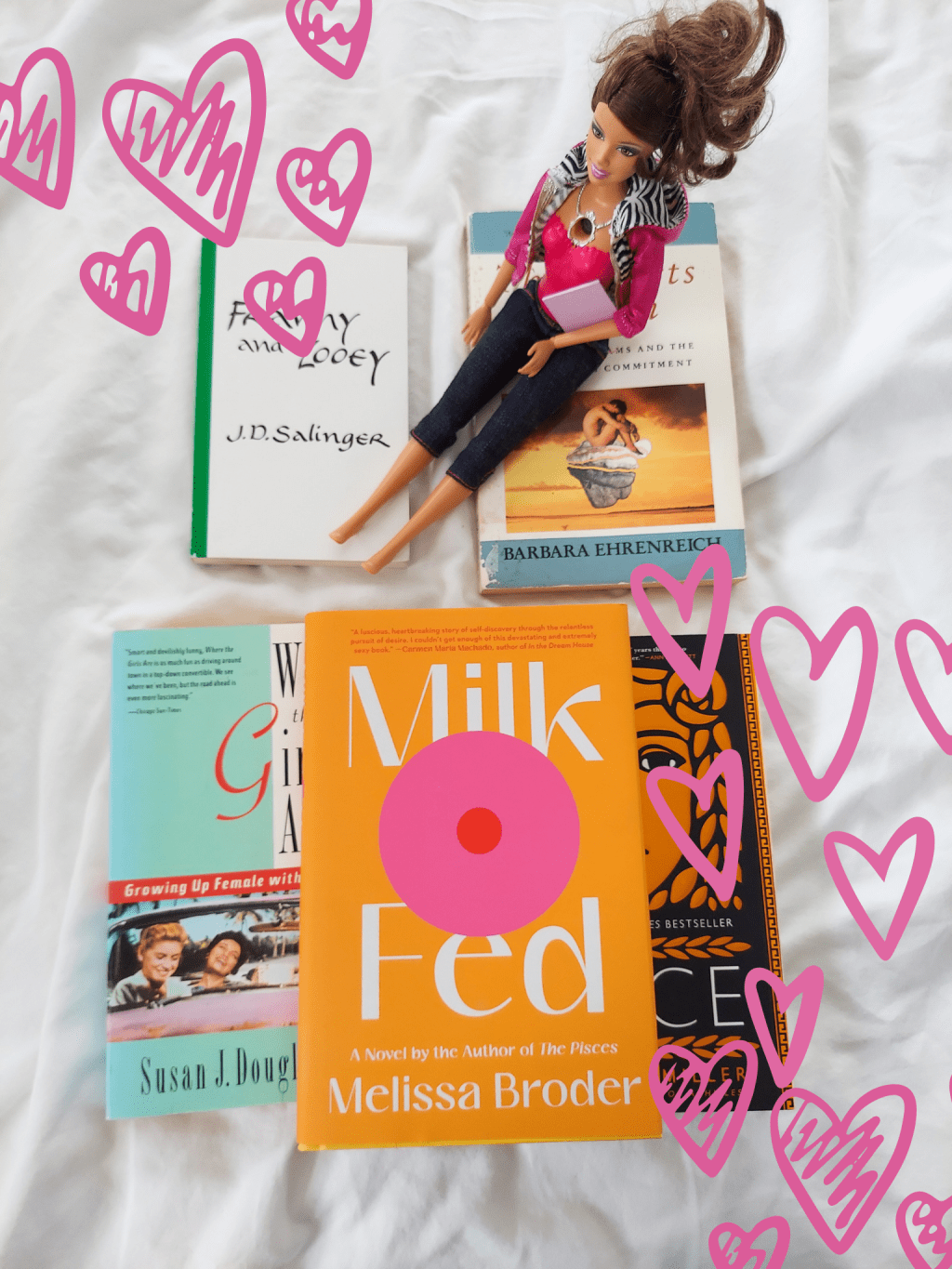
Franny and Zooey by J.D. Salinger
One of the movie’s themes I was surprised about was the relationship between the creator and the idea. The creator of Barbie, played by Rhea Jo Perlman, and Barbie have an intimate conversation about what they owe each other and what it means to live as an “idea” rather than a person.
This conversation immediately reminded me of Salinger’s book. This slim novel is a collection of a short story and novella centering around the Glass siblings, Franny and Zooey. Franny and Zooey discusses our relationship with a “creator,” whether it be God, the Universe, or the forces that shape our lives. This is a short book, but it packs a punch and touches on so many themes, like performance, spirituality, and authenticity.
Milkfed by Melissa Broder
It’s Contemplates Death Barbie!
As Barbie goes through a complete existential crisis, her perfect plastic walls shatter, and she realizes that to be human is to be imperfect. Struggling against the desire to be perfect versus reality reminded me of Broder’s novel.
In Milkfed, protagonist Rachel counts calories to assert some control over her life. Her rigid but miserable life unravels when she meets Miriam, the worker at her local frozen yogurt store. As she falls in love, she begins seeing joy in food and relationships.
The movie and book discuss perfectionism, control, personal fulfilment, and motherhood. Its prose is quick and engaging, just like the movie’s writing.
Where the Girls Are: Growing Up Female with the Mass Media by Susan J. Douglas
I read Douglas’ nonfiction book for my American Studies class, which is still one of my favorite books. Douglas traces the cultural history of girlhood, from the rigid conformity of the 50s, Beatlemania of the 60s, to the movies and television shows that defined an era.
Douglas examines the cultural forces that impacted teenage girls growing up through the lens of historical events and pop culture moments. Douglas argues that an immense fear of women’s liberation and empowerment lead to contradicting messages about how young women should look, behave, and feel. She provides historical context and insight with wit and intelligence that makes this a joy to read.
Gloria, played by America Ferrera, provides a moving monologue about the mixed messages women are taught and judged against throughout our lives. This monologue immediately reminded me of Douglas’s statement that women of previous decades faced restricting and contradicting messages from all media fronts.
I highly recommend Where the Girls Are if you love pop culture history or just history in general.
The Hearts of Men by Barbara Ehrenreich
She’s everything. He’s just Ken.
Ryan Gosling as Ken stole the show. When I saw Ken’s transformation from going to the real world and implementing a Ken-dominated social order back at Barbieland, I thought of this book.
Written by one of my absolute favorite nonfiction authors, I read this book for my American Studies class (yes, the same one as before) and it changed my outlook on history, especially on culture from the 1950s to 1980s.
Similar to Douglas’s cultural analysis during the same period, Ehrenreich’s central thesis is that while the women’s liberation movement occurred during the late 60s and early 70s, men were experiencing a cultural shift in the 50s and 60s that would have profound social implications.
Barbie focuses on the impact that rigid gender roles have on every member of society. Ehrenreich does a fantastic job of tracing the cultural shifts and expectations for young men over the decades.
Circe by Madeline Miller
Let’s talk about the end of Barbie.
Barbie has been on an incredible journey that has made her question everything she has ever known. While the other Kens run amok in Barbieland, she experiences the Real World: the messy, unfair, but incredibly vivid real world. She meets with Ruth, the creator of Barbie, and they hold hands, where images of what it would be like to be a woman flash by. In the end, Barbie sees these imperfect images and decides to live in the real world.
Daughter of a god and a nymph, Circe grows up ignored and unwanted until her knowledge of witchcraft sends her into exile. Over thousands of years, Circe hones her craft and comes into contact with a host of notable Greek legends, like Odysseus.
Circe’s journey from immortal to falling in love with mortals and being able to live a life reminded me of Barbie’s experience. And both endings made me sob. Something about the theme of immortals falling in love with humanity and wanting to live an imperfect mortal life that pierces me right through the heart every time I encounter it.
I feel like I could write an entire essay about my comparisons between Circe and Barbie (and maybe I will…comment below if you would actually read that).
So, there are all of my Barbie movie-inspired book recs! I had a blast making this list and could not believe how many books I thought about while watching this movie. Let me know in the comments what books reminded you of the film.
 The Library Mouse's Book Nook