I love January. That exciting rush when the new year starts, where all of your goals seem achievable. I love setting goals and thinking about all the fun possibilities that are ahead. Especially looking ahead at this new year, I have so many personal goals that I am excited to act on.
And if you are in that mindset, then you are looking for some inspiring reads to place you in the right headspace to get sh*t done. In celebration of the new year, here are my favorite “self-help” books that I can’t recommend enough…and one that I won’t recommend, which I saved for the end.
I placed “self-help” in quotes because when most people hear those words, their eyelids start to drop and they lose interest immediately. And I get it: I’ve read some heinous inspirational books that it was laughable how they could help anyone. But below are three life-changing books that made me view life differently, even years after reading them. These books are so good, that they transcend the often maligned “self-help” category.
In addition, I included my anti-recommendation: a marketed “self-help” book for twenty-somethings that did more damage than help.
Three self-help books to read in 2024
Atomic Habits: Tiny Changes, Remarkable Results by James Clear
I’ve talked about this book before and I will talk about it again. Odds are, you have heard of this book. Atomic Habits is the wildly successful book by author James Clear published in 2018. Clear provides an actionable system for achieving big goals, one small habit at a time. When we think of New Year’s resolutions, we think of going to the gym every day for hours, completely cutting out sugar, or other austere practices that never stick past Valentine’s Day. Instead, Clear highlights how we are meant to make habits that are simple, easy, and fun.
What I loved about this book was the emphasis on consistency over effort: just doing an action for five minutes a day every day for months is better than cycles of maximum effort until burnout. If this system sounds interesting, I wrote a full review that you can read here.
This is one of the best self-help books you can read. If you haven’t read it yet, give it a try.
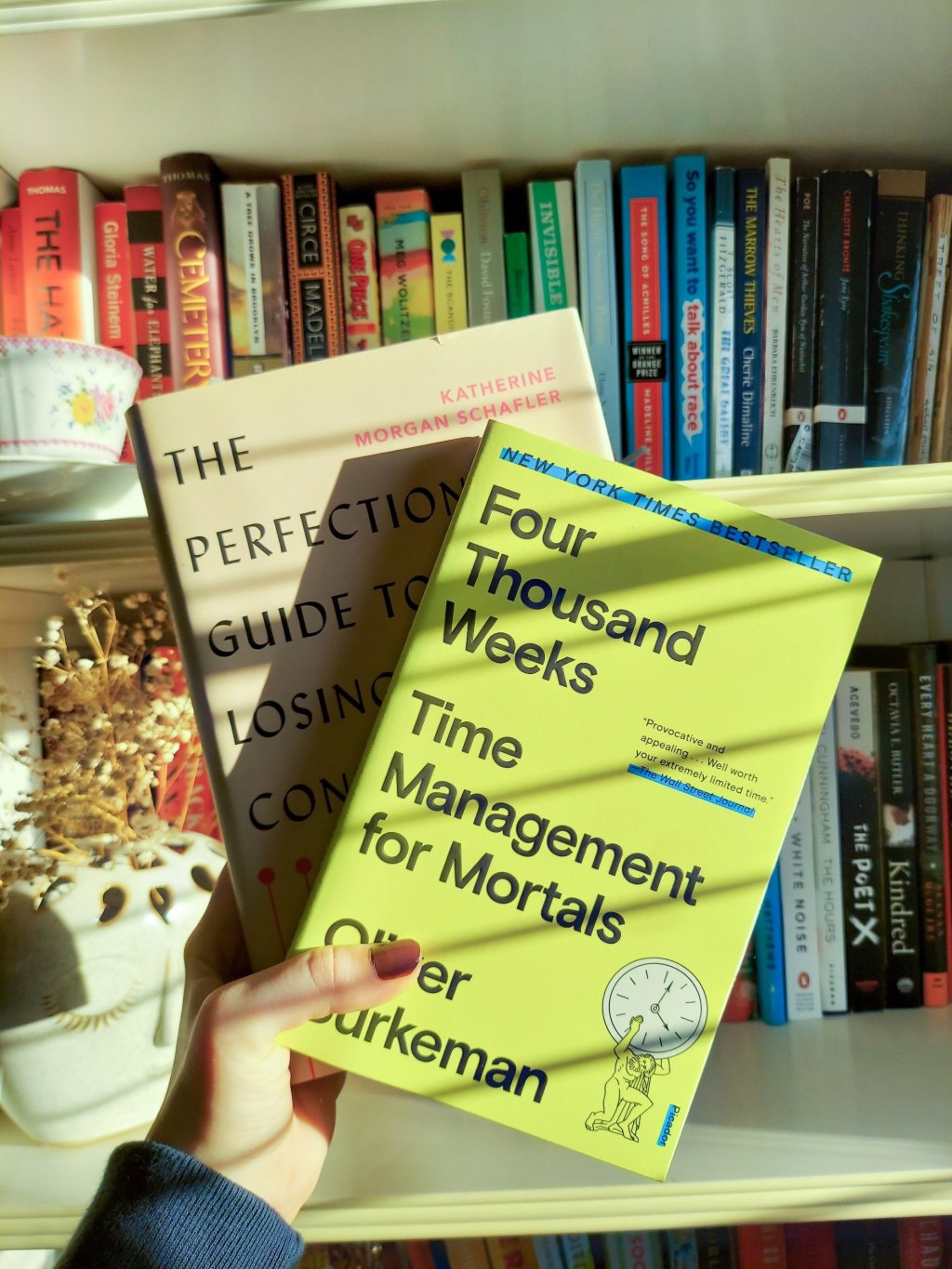
The Perfectionist’s Guide to Losing Control: A Path to Finding Peace and Power by Katherine Morgan Schafler
If you have ever struggled with feelings of perfectionism, of wishing you could be okay with average, or that your desires and goals are “too much,” then you need this book.
In the almost 300 pages that follow, Morgan Schafler argues that being a perfectionist isn’t a condition to be cured, but a source of strength and power. She writes about this subject with knowledge, wit, compassion, and practical advice. I adore how the author reframes perfectionism: instead of a defect to change, it can be transformed into a powerful attribute. You can read my full review here.
4,000 Weeks: Time Management for Mortals by Oliver Burkeman
If you have felt like there is never enough time in the day, then you need to read this book. Because as Oliver Burkeman points out, we have less time than we think we do.
Burkeman provides a stunningly clear thesis: most of us, if we are lucky, only have 4,000 weeks to live. That’s it. In the grand scheme of the history of the world, that is a drop of water in an entire ocean.
With lives as shockingly short as these, Burkeman argues, it is impossible to get everything you have ever wanted to get done, done. Burkeman rejects the idea that with productivity tips and hacks, it is possible to get more things done. Instead, he highlights our limitations and why these limitations make life worth living.
This book is inspiring, funny, insightful, and life-changing. It will make you laugh, cry, and stare at a wall for 10 minutes contemplating your life.
The Anti-recommendation
The Defining Decade: Why Your Twenties Matter— And How to Make the Most of Them by Meg Jay
HEAR ME OUT: this book is good. It is well-researched and offers important information. The author’s main thesis is that despite changing attitudes, your 30s are not the new 20s, and young adults should treat this time with the respect it deserves. Your twenties are a time for you to set your life up for success, both romantically, career-wise, and financially. That is great advice. But if you are already super driven and filled with the existential dread that if you don’t have your life together by 26 that a black hole will open up under you and suck you into the cold vacuum of space, then this book is a nightmare.
I am already an incredibly nervous person. I have always been a “pleasure to have in the class.” I did not need someone to tell me how important this time in my life is. I already know.
I read this on my twentieth birthday. I bought it as a birthday gift for myself and read it on the beach to celebrate. I am now 23, and this book has filled me with even more despair and anxiety about “making my twenties count” than normal levels. I’m not sure who this book is for: those who picked up this book, like me or my friends, are high-achievers and know how important this decade is for our development. With an audience like that, Jay is just singing to the choir.
The people who the author lists in this book as case studies, men and women now in their late 30s who realized this fact too late, I don’t think would be picking up this book.
In conclusion, read this book if you think it would help you. And believe me, it has some great advice. But if you are already anxious about your 20s and tend to place too much pressure on yourself already, congrats, you do not need this book.
 The Library Mouse's Book Nook